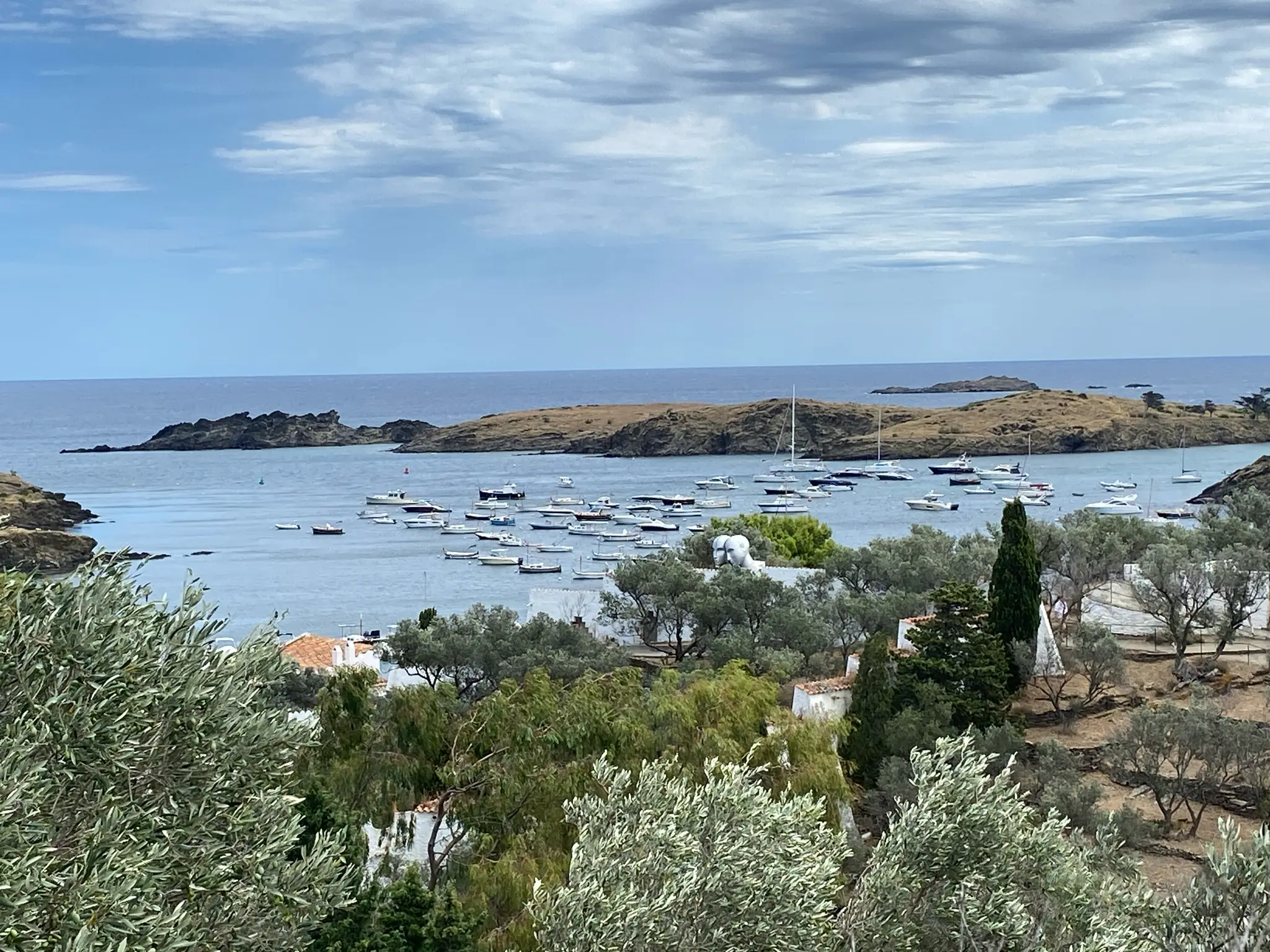
The Dalí Triangle is one of Catalonia's most famous cultural itineraries, but almost nobody does it by bike. From Ca La Fustereta, right in the centre of Figueres, you have the perfect starting point: the Teatre-Museu Dalí a five-minute walk away, and the Casa-Museu Dalí in Portlligat — the residence where Dalí lived and worked for forty years — as your route destination. Cadaqués, the village Dalí loved all his life, is the final scene. Landscape, art and effort in a single day.
This is an advanced route: 79.2 km with 750 m of cumulative elevation gain and nearly 5h30 of actual riding. It's not for beginners, but it's fully achievable for fit, experienced cyclists. The reward matches the effort: the views on the descent into Cadaqués rank among the most spectacular on the entire Costa Brava.
The route starts from Carrer Pi i Margall in the centre of Figueres. The first few kilometres thread through the town before heading northeast on quiet secondary roads. The Alt Empordà plain opens up ahead: vineyards, olive trees and cereal fields to the horizon, with the Albera hills behind you and Cap de Creus already visible in the distance.
This opening section is the least demanding of the day. The terrain is almost flat and lets you find your rhythm and warm up properly. Fill your bidons before you leave — water points thin out past the halfway mark. The village of Vilajuïga, about 20 km from the start, has a public fountain in the centre and makes a good early reference point.
This is where the route separates itself from anything else in the area. The road to Cadaqués crosses the Cap de Creus massif over a mountain pass with extraordinary views. The climb is steady rather than brutal: you gain altitude gradually through cork oaks and Mediterranean scrub, with the sea appearing and disappearing around every bend.
At the top of the pass the panorama opens completely: the Gulf of Roses to the west, the Medes Islands to the south, and directly ahead the bay of Cadaqués tucked between the mountains of the Cap de Creus Natural Park. The descent into the village is technical and sinuous — good brakes and full concentration required — but absolutely unforgettable. Few road descents in Catalonia offer this kind of spectacle.
Cadaqués is one of the most beautiful villages in the Mediterranean. Whitewashed houses, the baroque church of Santa Maria presiding over the harbour, fishing boats and a quality of light that fascinated Picasso, Man Ray, Marcel Duchamp and, of course, Salvador Dalí for decades. The seafront promenade and Port Alguer beach, right in the village centre, invite a generous pause.
There are bars and restaurants on every corner. We recommend at least 45 minutes: a coffee or a vermouth, something to eat and a short walk through the old town. You have 40 km of return ride ahead and it's worth leaving well rested and properly fuelled.
1.5 km from Cadaqués, following the coast road north, you reach the cove of Portlligat and the Casa-Museu Salvador Dalí. This was Dalí's main home for forty years: starting from the purchase of a single fisherman's hut in 1930, successive extensions created a labyrinth of rooms, terraces and gardens that is now the only museum in the world to preserve an artist's studio exactly as he left it.
Important: booking in advance is essential, through the Fundació Gala-Salvador Dalí website (salvadordali.org). Places are very limited and sell out weeks — sometimes months — ahead in high season. Sort your reservation well before the ride day.
Leave your bikes at the Portlligat car park and visit on foot. The house is compact but extraordinarily rich in detail: allow 60–90 minutes to see it properly. The lip-shaped swimming pool, the painting studio and the terrace overlooking the cove are among the most photographed spaces in all of Catalonia.
The return follows the same route in reverse. What was a descent becomes a climb, and your legs will already have kilometres in them. The climb out of Cadaqués is shorter than the one on the way in but steeper: this is the moment where energy management makes the difference. Leave the village at an easy pace and don't empty yourself on the first ramp.
Once over the pass, the Empordà plain opens up again and the final 25 km back to Figueres roll out in a gentle descent. If the tramuntana wind is blowing — very common in this area — you'll have it at your back and the last kilometres will feel almost effortless.
Looking for a gentler warm-up route? See our Figueres – Fluvià Dam – Besalú ride (56 km), ideal for exploring the inland Empordà.
Private garage, full workshop and every route at your door. In the centre of Figueres, 5 minutes from the Teatre-Museu Dalí.
Check availability →